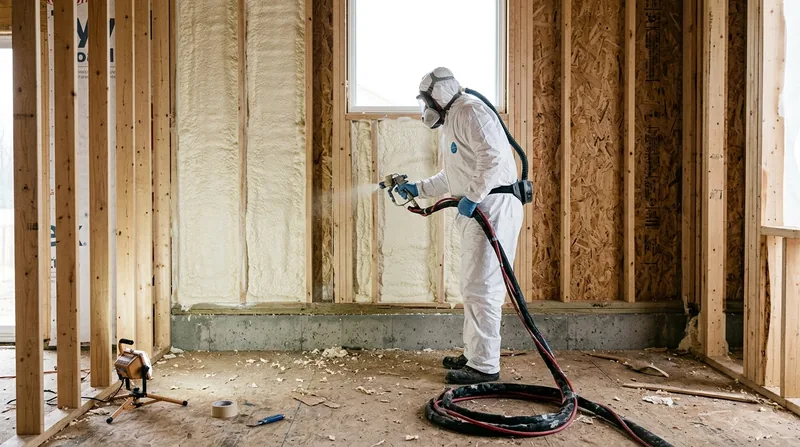




Commercial and new construction spray foam insulation in Eau Claire requires coordination from foundation to roof closure. Builders across Eau Claire, Lake Hallie, Chippewa Falls and the surrounding Chippewa Valley know that insulation decisions made before drywall closes the walls determine heating and cooling performance for decades. We work with general contractors and commercial property managers to install spray foam and air sealing at the critical framing stage, when access is open and the thermal envelope can be sealed continuously. Eau Claire's IECC zone 6A climate, with cold winters and humid summers, demands that new construction and commercial shells get the insulation and air sealing right the first time. Ice dams, rim joist leaks, and uncontrolled humidity in attics and wall cavities are the signature failures of this region, and they start with poor planning during construction. We help builders avoid those failures by installing spray foam and sealing air leaks before the building closes.
Why Spray Foam and Air Sealing Matter for New Construction and Commercial Projects in Eau Claire
New construction in Eau Claire faces a singular problem: the stack effect in zone 6A drives warm, humid air upward and outward during winter, and any gap in the thermal envelope or air barrier lets that air escape and brings cold, dry air in through rim joists, band joists, and wall penetrations. Commercial shells and new residential framing must be sealed continuously before drywall closes, or the building will fight humidity and temperature swings for its entire life. Spray foam and mechanical air sealing during framing allow builders to meet energy code, control vapor drive, and eliminate the callback complaints that plague rushed or incomplete insulation work.
- We coordinate spray foam installation with your framing schedule so crews are on site when access is open and walls are ready for closure.
- Closed cell spray foam provides the R-value and air barrier needed for commercial roofs, metal buildings and new residential attics in one pass.
- Open cell spray foam is cost-effective for new residential walls and interior applications where vapor permeability and sound dampening matter.
- We seal rim joists, band joists, header penetrations, and mechanical chases before drywall, eliminating the largest source of heating loss in Eau Claire homes.
- Air sealing at the framing stage costs far less than retrofitting after the building is closed and occupied.
Builders who plan insulation and air sealing during the permit and framing phase avoid costly callbacks and deliver homes and commercial spaces that perform as designed.
Key info: New construction permits in Eau Claire, Altoona, and Lake Hallie require compliance with the current Wisconsin Energy Code and IECC standards. Your local building official determines whether sealed attics, rim joist insulation, and wall foam need permits. We help you understand what applies to your project address and work with your builder to coordinate timing and inspections.
For more detail on how air sealing and foam work together, see our air sealing service page.
How We Coordinate Spray Foam Installation on New Construction and Commercial Projects in Eau Claire
Coordination is the difference between a smooth build and a delayed project. We work with your framing crew and general contractor to schedule spray foam installation at the moment walls are framed, roof decking is down, and mechanical systems are rough-in ready. We arrive on schedule, spray to the thickness and R-value your engineer or energy code requires, and leave the site clean so drywall and mechanical work can proceed without delay. We provide written estimates with R-value and thickness specifications for every zone of the building, so your crew and inspector know exactly what was sprayed and where.
- We meet with your builder or project manager before framing to confirm foam type, thickness targets, and schedule windows.
- Our crews arrive on the agreed date, spray all rim joists, band joists, roof decks, and wall cavities, and leave the site ready for the next trade.
- We provide a written estimate and job report that includes R-value, board feet, and thickness by zone, which satisfies energy code documentation and builder requirements.
- We coordinate with your mechanical contractor to ensure HVAC rough-in and ductwork do not interfere with foam application and cure.
- We manage ventilation and re-entry timing so your next crew can work safely as soon as foam is cured and outgassing is complete.
The result is a building that closes on schedule, passes inspection, and delivers the thermal performance and air tightness you designed.
Example: A new residential subdivision in Lake Hallie with 40 homes in framing phase needed rim joist and attic foam before drywall closure. We scheduled spray dates around the builder's framing and electrical rough-in, sprayed all homes in two weeks, and provided each homeowner with a certificate of R-value and thickness. The builder avoided callbacks and the homes qualified for energy code compliance without delay.
See our closed cell spray foam page for details on R-value and performance in commercial and residential applications.
Spray Foam Methods for New Construction and Commercial Projects
| Approach | Description | Best for |
|---|---|---|
| Closed Cell Spray Foam | High-density foam (3.5 to 4.5 lbs per cubic foot) providing R-value of 6.5 to 7.5 per inch, excellent air barrier, and moisture resistance. Requires mechanical ventilation during application and a 24-48 hour re-entry window. | Commercial roofs, sealed attics, rim and band joists, metal buildings, and new construction where space is limited and air tightness is critical. |
| Open Cell Spray Foam | Lower-density foam (0.5 to 1.5 lbs per cubic foot) providing R-value of 3.5 to 4 per inch, vapor-permeable, and sound-dampening. Cure time and ventilation requirements are shorter than closed cell. | New residential walls, interior partitions, and attics where cost control and sound absorption matter and moisture vapor can move freely. |
| Rim and Band Joist Foam | Closed cell spray foam applied to the top plate and band joist area of the foundation, sealing the transition from basement to first floor and eliminating cold air infiltration at the rim. | All new construction and commercial projects in Eau Claire, where rim and band joists are the single largest source of heating loss and ice dam formation. |
| Sealed Roof Deck Foam | Closed cell spray foam applied to the underside of roof sheathing, creating a continuous air barrier and insulation layer that prevents stack effect and ice dam formation. Requires compliance with thermal barrier and ignition barrier codes. | New commercial buildings, cathedral ceilings, and residential roofs in zone 6A where ice dams and attic moisture are predictable failure modes. |
Each method is selected based on the building type, available space, energy code requirements, and the specific moisture and thermal challenges of the Chippewa Valley climate.
Commercial and New Construction Spray Foam Cost in Eau Claire: What to Expect
The cost of spray foam insulation for new construction and commercial projects depends on the total square footage, foam type (open or closed cell), thickness required by code, and access to the application area. A new residential home in Eau Claire typically requires rim joist foam, attic foam, and wall foam, totaling 2,000 to 4,000 board feet depending on footprint and design. Commercial projects vary widely by building envelope size and complexity. The best way to establish a realistic budget is to request a free commercial estimate, which includes a site visit, measurement of all foam zones, and a written specification with R-value and thickness for each area.
Factors that affect the final cost include the total board feet of foam needed, whether existing insulation must be removed first, accessibility of the application area, and the thickness required to meet your energy code and design specifications. A straightforward new residential build with standard framing and clear access costs less per board foot than a complex commercial shell with mechanical obstacles and tight spaces. Building during the winter months in Eau Claire adds complexity because cold temperatures slow cure time and require extended ventilation, which can shift scheduling and labor costs.
We provide a detailed written estimate that breaks down cost by zone (rim joists, attic, walls, roof deck) and specifies R-value and thickness for each. This allows your builder or property manager to understand where the budget is allocated and to make informed decisions about foam type and coverage. For detailed pricing guidance and to schedule your free estimate, see our pricing page or contact us at (534) 444-6239.
What to Look for When Hiring a Spray Foam Contractor Near Me in Eau Claire
Choosing the right spray foam contractor for your new construction or commercial project is critical because the quality of the installation, the accuracy of the thickness and R-value, and the professionalism of the crew directly affect the building's performance and your ability to pass inspection. A reputable contractor provides a written estimate with R-value and thickness specifications, carries full insurance, and can explain their process for ventilation, re-entry timing, and compliance with local building codes. Avoid contractors who offer vague pricing, promise immediate re-entry, or cannot provide references from recent commercial or new construction projects in Eau Claire or the surrounding counties.
- Ask for a written estimate that specifies foam type, thickness in inches, R-value per zone, and total board feet, not just a price per board foot.
- Verify that the contractor carries full insurance and can provide a certificate of insurance naming your builder or project as an additional insured.
- Request references from at least two recent new construction or commercial projects in Eau Claire, Lake Hallie, or Chippewa Falls and contact them directly.
- Confirm that the contractor understands local permitting requirements and can explain what permits apply to your project address and building type.
- Ask about the contractor's ventilation plan during application and the stated re-entry window (typically 24 to 48 hours for closed cell foam) so your schedule is accurate.
- Check that the contractor can provide a job report after completion documenting R-value, thickness, and board feet by zone for your records and inspector.
A contractor who answers these questions clearly and provides detailed documentation is demonstrating the professionalism and transparency that new construction and commercial projects require. For a free estimate and to discuss your project timeline, contact us at (534) 444-6239.
Commercial & New Construction Spray Foam in Eau Claire: Pricing Guide
| Service | Price | Details |
|---|---|---|
| Free Commercial Estimate | No charge | Site visit, measurement of all foam zones, written spec with R-value and thickness by area |
| Residential New Construction (typical home) | Starting at $2,800 | Rim joist, attic, and wall foam for 2,000 to 3,500 board feet, closed or open cell per plan |
| Commercial Shell or Large Multi-Unit | On estimate | Building envelope size, foam type, accessibility, and code requirements determine final scope and cost |
| Existing Insulation Removal (if required) | On estimate | Removal of old fiberglass or cellulose before new foam application adds labor and disposal costs |
| Travel and Site Coordination | Included | No separate mileage or travel fee within Eau Claire and surrounding service area counties |
| Written Job Report | Included | R-value, thickness, board feet by zone, and compliance documentation for your inspector and builder |
Indicative pricing, the exact cost depends on square footage, finish, and site access. Free personalized estimate within 24h at (534) 444-6239.


