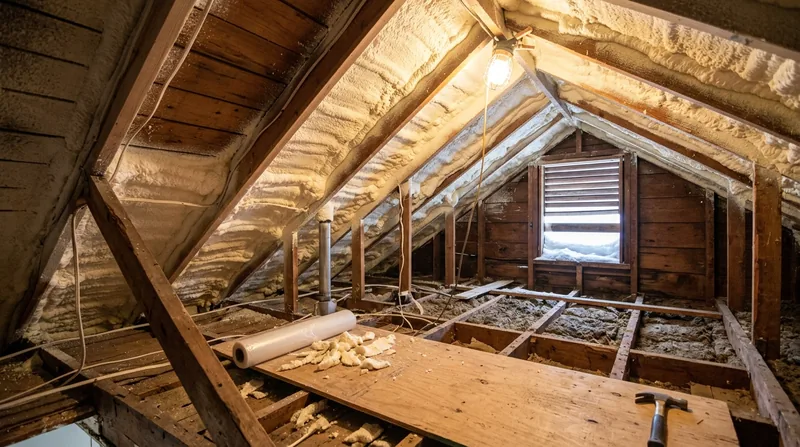




Attic spray foam insulation in Eau Claire stops the ice dams that form every winter along the eaves of homes from the Third Ward to Lake Hallie. Warm, humid air rises through ceiling penetrations and top plates, meets the cold roof sheathing above, and condenses into the moisture that drives ice buildup and water intrusion. Spray foam applied directly to the roof deck seals that attic plane completely, blocking stack effect and keeping indoor humidity away from the cold surface where dew point is reached. Eau Claire sits in IECC zone 6A with winters that demand this kind of control, and the city's mix of early 1900s bungalows, mid-century ranches, and newer subdivisions all carry the same vulnerability. We spray foam to the roof, not the attic floor, because that is where the thermal boundary belongs in a cold climate where the attic must stay cold and dry. The result is a sealed attic plane that stops air leakage, controls moisture, and cuts the heating load that drives winter bills higher.
Why Attic Spray Foam Insulation Matters in Eau Claire and the Chippewa Valley
Eau Claire's housing stock sits in the path of cold air masses that flow off the Chippewa River valley each winter. The city's older bungalows near downtown and the Third Ward, along with mid-century ranches across Eau Claire, Chippewa Falls, and Altoona, were built before modern air sealing became standard. Every one of these homes has an attic where warm indoor air naturally rises by stack effect, seeking the path of least resistance to the cold outdoors. When that air meets an attic plane that is not sealed, it carries moisture into the insulation and against the roof sheathing. In zone 6A, roof sheathing temperature drops well below the dew point of indoor air during winter, so condensation happens, frost forms, and ice dams grow along the eaves where gutters sit.
- Attic air leakage through top plates, around recessed lights, and past ductwork allows humid indoor air to reach cold roof sheathing and freeze into ice dams.
- Spray foam applied to the roof deck creates a sealed thermal boundary that stops air movement and blocks moisture from reaching the cold surface.
- A sealed attic plane reduces the heating load by eliminating the stack effect that pulls warm air upward and out of the living space.
- The foam also provides the R-value needed to keep the attic plane itself above the dew point, preventing condensation on the underside of the roof sheathing.
Ice dams are not just a cosmetic problem. They force water back under shingles, into the attic, and down into walls and ceilings where it causes rot, mold, and structural damage that costs thousands to repair. Sealing the attic plane stops the source.
Key info: Eau Claire and Chippewa Falls homes lose the most heat through attics because warm air rises and escapes through any gap in the ceiling plane. A single 1-inch hole in a top plate is equivalent to leaving a window open all winter. Spray foam seals every penetration at once, stopping the leak that fiberglass and blown-in insulation cannot reach.
For more information on how air sealing works alongside insulation, see our air sealing service page.
How We Spray Foam Your Attic: The Process in Eau Claire
Attic spray foam starts with a thorough inspection of the roof plane, all penetrations, and the existing insulation. We identify where warm air is leaking, where moisture risk sits, and whether the existing insulation can stay or must come out. If the attic carries old, compressed, or water-damaged insulation, we remove it first so the foam adheres to a clean, dry substrate. Once the space is ready, we spray closed cell or open cell foam directly to the roof deck, building thickness in passes to achieve the R-value and coverage needed for Eau Claire's climate. The foam expands and hardens, sealing every crack, corner, and penetration in one continuous barrier. We control the application rate, temperature, and ventilation during cure to ensure the foam sets correctly and the attic is safe to re-enter within 24 to 48 hours.
- We inspect the attic space, roof deck, and all existing insulation to plan the scope and identify moisture or contamination that must be addressed first.
- We remove old, failed, or water-damaged insulation if it is in the way of the foam application or if it is trapping moisture against the roof.
- We apply spray foam in controlled passes, building to the R-value specified in your estimate, with the drum temperature and ratio monitored to manufacturer specs.
- We provide mechanical ventilation during cure and specify a re-entry window so you know when the attic is safe to walk and store items again.
- We seal the attic access, hatch, or pull-down stairs so the thermal boundary is complete and air cannot leak around the entry point.
The entire process is a single, integrated job. We do not spray foam over wet substrates, active leaks, or contaminated materials. If the roof is leaking or the attic has standing water, we identify that in the estimate and walk away if it is not fixed first. That discipline is what separates a quality installation from a rig-and-run job that leaves the homeowner with a smell, a bill, and a problem that will not go away.
Example: A 1960s ranch in Lake Hallie with blown-in fiberglass settled over a sagging attic floor, cellulose dust in the air, and ice dams forming every winter. We removed the old insulation, sealed the attic plane to the roof with closed cell foam, and brought the R-value to code for zone 6A. The homeowner reported no ice dams the following winter and a measurable drop in heating costs. See our closed cell spray foam page for more detail on when closed cell is the right choice.
Methods and Materials: Closed Cell vs. Open Cell for Eau Claire Attics
| Approach | Description | Best for |
|---|---|---|
| Closed Cell Spray Foam | Dense, rigid foam that expands to fill cavities and hardens into a moisture barrier. R-value 6.0 to 7.0 per inch. Low permeability stops vapor drive into the roof deck. | Sealed attic planes in zone 6A where moisture control and air sealing are the priority. Attics with existing roof leaks or high humidity risk. |
| Open Cell Spray Foam | Softer, permeable foam that expands to seal air leaks but allows vapor to move. R-value 3.5 to 4.0 per inch. Lower cost per board foot than closed cell. | Attics where air sealing is the goal and the roof deck is already protected by vented soffit and ridge ventilation. Budget-conscious retrofits of sound attics. |
| Blown-In Insulation (Fiberglass or Cellulose) | Loose fill applied over attic floor. Does not seal air leaks or penetrations. R-value 3.2 to 4.0 per inch depending on material. Settles over time. | Top-up of existing attic insulation when the attic plane is already sealed, the roof is sound, and the goal is R-value only. Not a solution for air leakage or moisture. |
| Insulation Removal and Replacement | Complete removal of old, failed, or contaminated insulation followed by spray foam or blown-in replacement. Includes disposal and cleanup. | Attics with water damage, mold growth, rodent contamination, or insulation that is blocking ventilation. Mandatory before any new foam installation. |
For Eau Claire's climate and the ice dam risk that dominates winter heating loss, closed cell spray foam to the roof deck is the most effective choice. It seals air leakage, stops moisture, and provides the R-value needed to keep the attic plane above dew point. If your attic is sound and simply under-insulated, blown-in insulation may be the right answer and we will tell you so. Our job is to fit the material to the problem, not to sell the most expensive option.
Attic Spray Foam Insulation Cost in Eau Claire: What to Expect
Spray foam pricing in Eau Claire starts at $1.50 per square foot for a basic attic plane sealed to the roof deck with closed cell foam. The final cost depends on the size of the attic, the R-value required by code at your address, the condition of the substrate, and whether existing insulation must be removed first. A 1,200-square-foot attic on a ranch in Eau Claire or Lake Hallie typically runs $1,800 to $2,400 for closed cell to R-21 or R-24, plus removal costs if old insulation is in the way. Attics in larger homes or those requiring removal of damaged insulation can reach $3,000 to $5,000. The price is also affected by attic access, ductwork layout, and the number of penetrations that must be sealed.
We provide a written estimate that specifies the R-value, the thickness in inches, the board feet of foam, and the total cost. We do not quote a price per board foot over the phone because every attic is different and a number given without an inspection is a guess. Travel to Eau Claire, Altoona, Chippewa Falls, and surrounding areas is included in the price, with no separate mileage or call-out fee. For a detailed breakdown of pricing and factors that affect cost, see our full pricing page.
Getting 2 or 3 estimates is smart. A low price with no specification of R-value and thickness is a warning sign. An estimate that promises immediate re-entry or does not mention ventilation during cure is another. The right contractor will spend time on the inspection, provide a detailed scope, and explain why the foam is the right choice for your attic and your climate.
What to Look for When Hiring an Attic Spray Foam Insulation Contractor Near Me in Eau Claire
Hiring a spray foam contractor is a bigger decision than hiring a general handyman because the material is applied inside your home, the application requires equipment and skill, and poor work can create odor, off-gassing, or incomplete sealing that you live with for years. Start by asking any contractor for proof of full insurance coverage and a certificate of insurance. Ask for references from recent jobs in Eau Claire or nearby cities and call them. A contractor who has been in business since 2012 and has local roots is more likely to stand behind the work than a rig-and-run crew in a trailer with out-of-state plates.
- Verify that the contractor is fully insured with coverage for property damage and bodily injury, and ask for a certificate before work begins.
- Request a written estimate that specifies R-value, thickness in inches, the total board feet of foam, and the cost, with no vague language or per-board-foot quotes.
- Ask whether the contractor will ventilate the attic during cure and what re-entry window they specify, typically 24 to 48 hours after application.
- Check with the Eau Claire building department or your city's permitting office to understand whether a permit is required for attic insulation at your address.
- If you live in an HOA community, confirm that the attic work does not trigger architectural review, though interior insulation rarely does.
- Ask the contractor to explain why they are recommending closed cell versus open cell, or blown-in insulation, and listen for an answer that fits your attic and climate, not just the highest price.
The best indicator of quality is a contractor who spends time on the inspection, asks detailed questions about your heating bills and any moisture or ice dam problems, and provides a clear, itemized estimate before any work starts. If something feels rushed or the price is far below what other contractors quote, trust your instinct. For a free, no-obligation estimate from our team, call us at (534) 444-6239 or visit our contact page.
Attic Spray Foam Insulation in Eau Claire: Pricing Guide
| Service | Price | Details |
|---|---|---|
| Closed Cell Spray Foam to Roof Deck | Starting at $1.50/sq ft | Complete attic plane seal to code R-value for zone 6A, includes all penetrations and top plates |
| Open Cell Spray Foam to Roof Deck | Starting at $1.15/sq ft | Air sealing with lower cost per square foot, best for sound attics with existing ventilation in place |
| Insulation Removal and Replacement | Starting at $0.75/sq ft | Removal of old, failed, or contaminated insulation plus disposal and cleanup before new foam application |
| Large or Complex Attics | On estimate | Attics over 2,000 square feet, multiple roof planes, or substrate issues requiring site inspection and detailed scope |
| Travel and Service Call | Included | No mileage fee or call-out charge for Eau Claire, Altoona, Lake Hallie, Chippewa Falls, and surrounding areas |
| Free Written Estimate | Free | Detailed quote with R-value, thickness, board feet, and cost. No obligation to proceed. Response within 24 hours |
Indicative pricing, the exact cost depends on square footage, finish, and site access. Free personalized estimate within 24h at (534) 444-6239.


