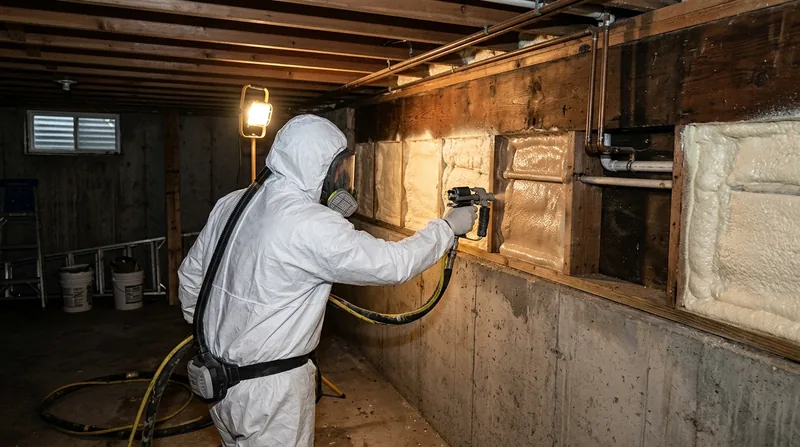




Closed cell spray foam insulation in Eau Claire addresses the specific moisture and air leakage challenges that define basements and rim joists across the Chippewa Valley. Eau Claire's housing stock, from early 1900s bungalows near downtown to mid-century ranches and newer subdivisions toward Lake Hallie and Altoona, sits almost universally over full basements where cold air off the Chippewa River settles against foundation walls each winter. That rim joist and band joist at the top of the foundation is where condensation risk peaks, where vapor drive meets cold concrete, and where uncontrolled air leakage pushes heating costs up month after month. Closed cell foam delivers the rigid density and moisture resistance that open cell cannot match in below-grade and foundation applications. It seals tight, resists vapor transfer, and holds its R-value in the damp conditions that characterize Eau Claire basements year-round.
Why Closed Cell Spray Foam Matters for Eau Claire Basements and Rim Joists
Eau Claire's full basements and rim joists face a predictable failure cycle every cold season. Warm indoor air rises by stack effect, meets the rim joist area where the band joist sits atop the foundation wall, and encounters cold exterior surfaces. If that junction is sealed only with fiberglass batts or is left open to the rim cavity, air leakage and moisture condensation follow. In winter, that moisture freezes and thaws, degrading insulation and creating the conditions for mold growth on rim joists and band joists across the city and into Chippewa Falls, Dunn County, and the surrounding counties. Closed cell foam stops both air leakage and vapor transfer in a single application, adding structural rigidity and eliminating the voids where moisture collects.
- Closed cell foam resists moisture transfer far better than open cell, which absorbs water and loses R-value when wet.
- The rigid foam adds bracing strength to the rim joist and band joist, reinforcing the foundation top plate against seasonal movement.
- A single, continuous application seals all air leakage paths at the rim, eliminating cold drafts that rise through floors above the basement.
- Closed cell foam does not absorb humidity from basement air, so it maintains performance even in older homes with periodic condensation.
These properties make closed cell the standard choice for foundation and basement insulation across the Chippewa Valley and beyond.
Key info: Wisconsin's IECC Zone 6A climate drives cold-weather condensation risk from October through April. A rim joist in Eau Claire that sits uninsulated or filled with degraded fiberglass will lose heat continuously and collect condensation every winter. Closed cell foam, applied to the full perimeter of the rim and band joist, eliminates that loss and that moisture risk in a single job.
For official guidance on insulation requirements and thermal barrier rules in your address, consult the City of Eau Claire Building Department or your local municipal building official.
How We Install Closed Cell Spray Foam on Rim Joists and Band Joists in Eau Claire
Closed cell spray foam installation on rim joists and basements follows a methodical sequence designed to ensure complete coverage, correct thickness, and proper curing. We begin with a site inspection to identify the full perimeter of the rim joist, assess access from basement or crawl space, and confirm that the substrate is dry and free of standing water or active leaks. If moisture is present, we do not spray; we address the leak first or we walk away. Once the area is confirmed dry and ready, we mask off adjacent surfaces, position equipment, and spray the foam in controlled passes to achieve the specified R-value and thickness.
- We inspect the rim joist and band joist perimeter, confirm substrate dryness, and identify any active moisture sources before scheduling the spray date.
- On spray day, we set up mechanical ventilation to manage off-gassing and maintain indoor air quality during the application and cure period.
- We apply closed cell foam in controlled passes, maintaining the manufacturer's specified drum temperature and mix ratio to ensure proper expansion and density.
- After application, we observe a re-entry window of 24 to 48 hours before the space is used normally, allowing the foam to cure fully and off-gases to dissipate.
- We trim excess foam and install any required thermal or ignition barriers per local code, then verify the finished thickness and coverage with the homeowner.
This disciplined approach is why we deliver consistent results and why homeowners across Eau Claire and Lake Hallie trust us to handle their foundation insulation.
Example: A 1960s ranch in Eau Claire with a basement that floods slightly during spring thaw and a rim joist that shows condensation each winter had a band joist treated with 2 inches of closed cell foam, applied from the basement side. The foam sealed all air leakage, stopped condensation on the rim and floor framing above, and added 12 to 14 R-value to that critical junction. The homeowner reported noticeably warmer floors and no condensation the following winter.
For more on how we approach basement and foundation insulation, see our page on rim joist and band joist spray foam insulation.
Closed Cell Spray Foam Applications and Methods
| Application | Description | Best for |
|---|---|---|
| Rim and Band Joist | 2 to 3 inches of closed cell foam applied to the full perimeter where the band joist meets the foundation top plate. | Eliminating air leakage and condensation at the foundation, reducing heating loss through floors above basements. |
| Basement Walls | Closed cell foam sprayed 2 to 4 inches thick on interior basement walls, stopping just short of the floor slab. | Homes with uninsulated basements or damp basements where vapor control and thermal resistance are both required. |
| Sealed Crawl Spaces | Closed cell foam applied to band joists and rim framing in crawl spaces, with coverage extending down walls if specified. | Crawl spaces where moisture control and air sealing are the primary goals, common in older Eau Claire homes. |
| Attic Rafter Bays (Sealed Roof Decks) | 3 to 5 inches of closed cell foam sprayed directly to the underside of roof sheathing to create a sealed, conditioned attic. | New construction or major roof retrofits where unvented attics eliminate ice dam risk and allow HVAC ducts in the attic plane. |
| Garage Walls and Ceilings | Closed cell foam applied to garage walls and ceiling areas over conditioned living space, providing both insulation and air sealing. | Attached garages in Eau Claire where heating loss to the garage is significant and garage condensation control is needed. |
Closed Cell Spray Foam Insulation Cost in Eau Claire: What to Expect
Closed cell spray foam insulation in Eau Claire typically starts at $1.20 per board foot and can range higher depending on job complexity, access, substrate condition, and the total square footage being treated. A typical rim joist and band joist application around a basement might run 200 to 400 board feet, placing it in the $240 to $480+ range before any ancillary work. Larger jobs, such as basement wall insulation or sealed attic installations, can reach 1,000 to 3,000 board feet and scale accordingly. The cost per board foot reflects the material cost of the closed cell resin and hardener, the labor to spray it safely and accurately, equipment operation, mechanical ventilation during cure, and our fully insured service.
Several factors influence the final cost. If the substrate is wet or requires moisture remediation before foam can be applied, that adds time and may require drying equipment or leak repair first. If access is tight, such as a low crawl space or an attic with limited headroom, labor time increases. If the rim joist or basement wall has irregular surfaces, protrusions, or existing insulation that must be removed, that adds scope. Thickness and R-value requirements also affect the board feet: 2 inches delivers roughly 13 R-value in closed cell, while 3 inches delivers 19 to 20 R-value. We provide a written estimate specifying R-value, thickness, and board footage so you know exactly what you are paying for and why.
The smartest approach is to get 2 to 3 estimates from contractors who provide written specifications with R-value, thickness, and board foot counts. Be cautious of estimates with no R-value stated, no thickness specified, or a price far below market; these are often signs of poor workmanship or incomplete scope. For detailed pricing and examples, see our pricing page.
What to Look for When Hiring a Closed Cell Spray Foam Insulation Contractor Near Eau Claire
Finding a qualified spray foam contractor near Eau Claire requires more than a phone number and a low bid. The spray foam trade includes both local independent shops and national franchises, and it also includes rig-and-run crews that spray a job in an afternoon, collect payment, and disappear when the smell will not go away or when the foam fails to cure properly. The difference between a professional installation and a poor one often comes down to technique, equipment, and accountability. Here is what to verify before you hire anyone, including us.
- Confirm that the contractor is fully insured and ask to see a current certificate of insurance with spray foam work explicitly listed as a covered activity.
- Request a written estimate that specifies R-value, foam thickness in inches, total board footage, and the cost per board foot, so you can compare apples to apples across multiple bids.
- Ask whether the contractor will maintain mechanical ventilation during the spray and cure period, and what re-entry window they recommend before the space is occupied.
- Check references from recent jobs in Eau Claire, Chippewa Falls, Lake Hallie, or nearby areas, and ask whether the foam cured properly and whether any odor or off-gassing issues occurred after the job.
- Verify that the contractor understands local building code requirements for thermal barriers and ignition barriers, and confirm that they will work with the local building department if a permit is required at your address.
- Ask about the contractor's policy on wet substrates: a professional will refuse to spray over wet, leaking, or contaminated surfaces and will address the moisture first.
These steps protect you from costly mistakes and ensure that your closed cell spray foam installation meets code, performs as promised, and lasts for decades. Call us at (534) 444-6239 for a free, no-obligation estimate, and we will walk you through the scope and answer any questions about how we work.
For more information and to schedule your free estimate, visit our contact page.
Closed Cell Spray Foam Insulation in Eau Claire: Pricing Guide
| Service | Price | Details |
|---|---|---|
| Rim Joist and Band Joist (Basement Perimeter) | Starting at $1.20/board ft | Typical 200 to 400 board feet, depending on basement perimeter length and foam thickness applied |
| Basement Wall Insulation (Full or Partial) | Starting at $1.20/board ft | Larger scope, often 500 to 1,500 board feet; final cost depends on wall area, substrate condition, and thickness |
| Sealed Attic or Roof Deck Installation | Starting at $1.20/board ft | Typically 1,000 to 3,000 board feet; cost scales with attic square footage and rafter spacing |
| Moisture Remediation or Substrate Preparation | On estimate | If the substrate is wet or requires drying before foam can be applied, this work is assessed separately on site |
| Insulation Removal and Disposal | On estimate | If existing insulation must be removed before closed cell foam is applied, cost depends on material type and volume |
| Free Estimate | No charge | Written estimate with R-value and thickness specs provided within 24 hours; call (534) 444-6239 |
Indicative pricing, the exact cost depends on square footage, finish, and site access. Free personalized estimate within 24h at (534) 444-6239.


